The MEP professionals have found the biggest privilege in Building Information Modeling. This software offers engineers, architects, and contractors the powerful tools that they can use in order to streamline their projects.
With Revit as BIM’s platform, it offers a solution. Therefore, plumbing engineers and MEP teams can be more accurate, collaborate more efficiently, document quickly, and have fewer clashes with the help of Revit BIM services. Read more to see how to achieve this efficiency.
The plumbing design challenge and how Revit steps in
Conventional plumbing design processes typically use individual 2D CAD drawings for water supply, drainage, venting, and fixtures. Such drawings are likely to be misaligned with structural or architectural features, concealed conflicts, and late identification of the problems.
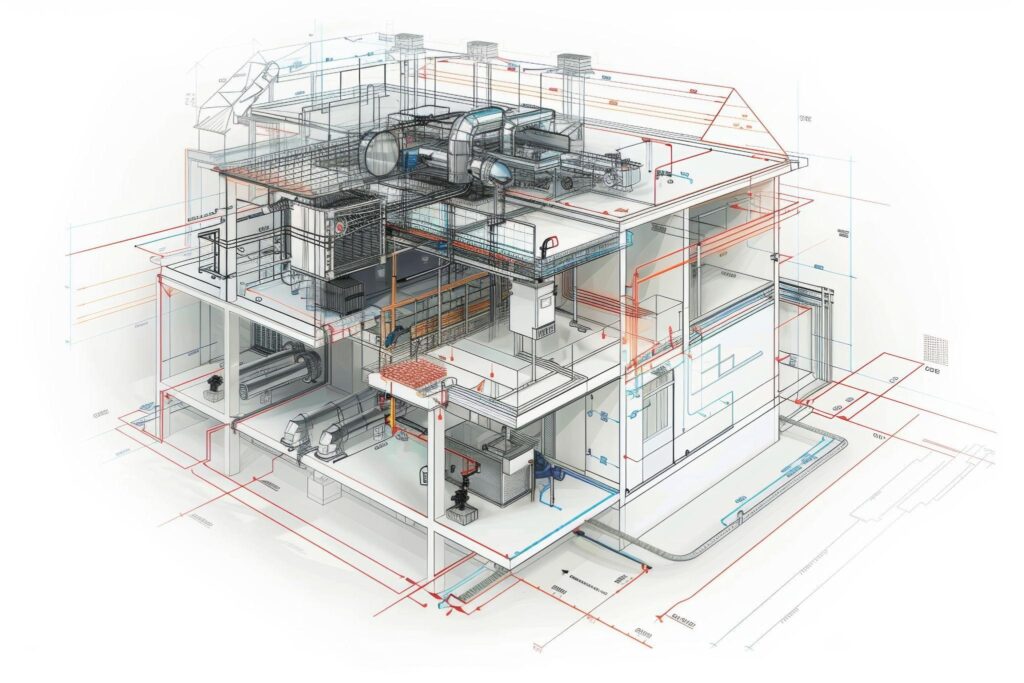
Revit is used as a part of BIM (Building Information Modeling) processes to create a 3D representation of the plumbing network of the building in the presence of the building geometry and all the other systems (structural, architectural, MEP).
With this integrated model, teams working on plumbing can visualise routing, detect clashes early, and automatically update the layout when changes occur elsewhere in the model.
For example, Revit allows real-time coordination such that when structural members shift, plumbing runs adjust, or at least flag issues immediately.
The overall adoption of BIM is increasing: a report estimated that 51% of MEP and structural engineers have used BIM on 50% or more of their projects.
How Revit BIM services unlock plumbing design efficiency
1. 3D modelling and visualisation
The designers will have a clearer view of routing, clashes, and complex geometries by developing a complete 3-dimensional display of the plumbing network with the help of Revit services / Revit 3D modeling.
For example, the plumbing systems can also be viewed and looked at differently in the virtual 3D model.
The capability to visualize in 3D on top of 2D will allow MEP professionals to find clashes and enhance coordination in general.
2. Clash detection and coordination with other fields
When the plumbing systems interfere with the structural elements, ducts, or architectural finishes, this is also one of the greatest sources of rework in construction.
These conflicts are identified early on with the help of Revit and BIM coordination, as opposed to on-site amendments, which would be costly. Real-time coordination removes a large number of problems found with the manual adjustments in CAD, resulting in better outcomes.
3. Parametric families and reuse of design elements
Revit 3D modeling can be used to create and utilize parametric “families” of plumbing components (pipes, valves, fixtures), which can be reused in any project and can be easily adapted.
The family enables the production of 3D parametric objects in plumbing with numerous repeated design elements. Revit families will save time and save on the repetition of work.
4. Automated documentation and reduced manual effort
When the model is built in Revit, documentation for fabrication, installation, and shop drawings can be extracted more automatically.
This eliminates redundant manual drafting, reduces error rates, and accelerates project delivery. One vendor notes: by automating repetitive tasks like calculating pipe sizes, flow rate, and pressure losses, teams can focus on more complex design challenges.
Maximize efficiency in Revit plumbing.
- Start with clean building geometry and a clear model setup
- Use well-defined para metric families
- Establish coordination workflows early
- Maintain model data integrity
- Update the model throughout the project, or get professionals to do it
Enhance your Revit plumbing design with a reliable partner
The benefits of the Revit services adoption in plumbing design are quite convincing: the reduced number of clashes and rework, quicker documentation, enhanced interdisciplinary coordination, and an enhanced use of design objects. Consider the fact that half of MEP engineers are currently utilizing BIM in most of their projects.
Transform how your team designs and collaborates. Contact CMLC Consulting today to see how our Revit BIM services can elevate your project workflow.