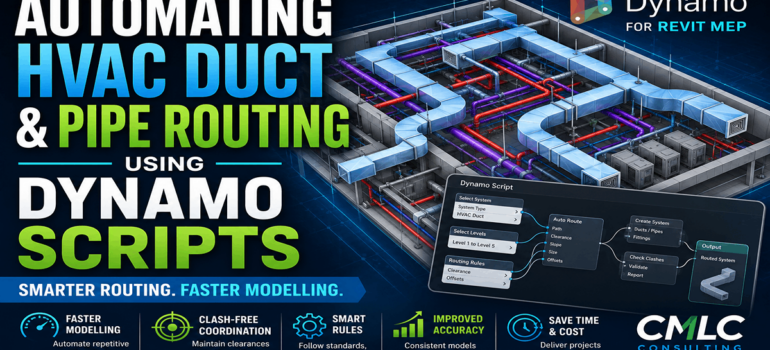
Automating HVAC Duct & Pipe Routing Using Dynamo Scripts

Automating HVAC Duct & Pipe Routing Using Dynamo Scripts
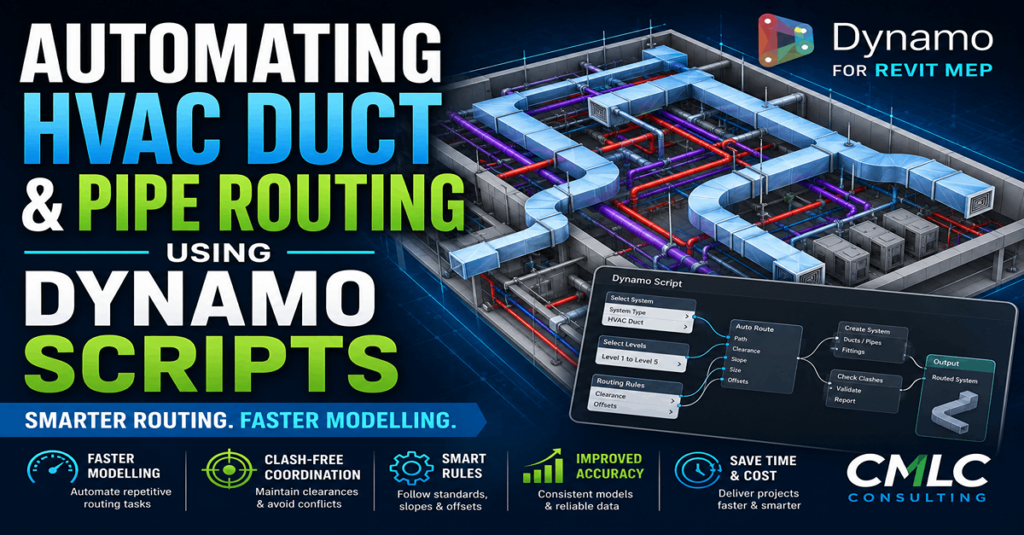
Automating HVAC Duct & Pipe Routing Using Dynamo Scripts

As MEP systems become increasingly complex, traditional manual routing of HVAC ducts and piping in Revit often leads to longer modelling times, coordination errors, and costly rework. To address these challenges, the AEC industry is rapidly adopting Dynamo automation for Revit MEP, enabling faster, smarter, and more consistent system routing.

At CMLC Consulting, we leverage Dynamo scripts for automated HVAC duct and pipe routing to enhance modelling efficiency, improve BIM coordination, and deliver high‑quality, constructible MEP BIM models.


Why Automate HVAC Duct & Pipe Routing?

Manual routing in dense MEP environments is time‑consuming and prone to clashes. Automation using Dynamo allows project teams to:

  • Reduce repetitive modelling tasks
  • Maintain consistent routing logic and standards
  • Improve coordination across disciplines
  • Quickly adapt to design changes

These benefits are especially critical on large‑scale commercial, healthcare, industrial, and infrastructure projects where routing complexity is high.

Explore our advanced MEP BIM Services:
 👉 https://cmlcconsulting.com/mep-bim-services.php


What Is Dynamo for Revit MEP?

Dynamo is a visual programming tool that works within Revit, allowing BIM professionals to create scripts that automate tasks without traditional coding. In MEP workflows, Dynamo is used to:

  • Auto‑route HVAC ducts and piping
  • Apply slope rules for drainage systems
  • Maintain clearance from structural elements
  • Generate system layouts based on predefined parameters

At CMLC Consulting, Dynamo is integrated into our computational BIM workflows to support scalable, rule‑based MEP modelling.


Dynamo‑Driven HVAC & Pipe Routing Workflows at CMLC Consulting

1. Rule‑Based Routing Logic

CMLC develops Dynamo scripts that follow project‑specific design standards, including:

  • Preferred routing paths
  • Minimum clearances
  • System hierarchy and offsets

This ensures automated routing remains code‑compliant and constructible.

2. Clash‑Aware Automation

Dynamo scripts are used alongside federated BIM models to avoid clashes with architectural and structural elements.

Our coordinated approach is supported by:
 👉 BIM Coordination Services
 https://cmlcconsulting.com/bim-coordination-services.php


Integration with Multi‑Disciplinary BIM Models

Automated MEP routing must align with architectural intent and structural constraints. CMLC ensures seamless integration through:

This multi‑disciplinary coordination reduces clashes early and supports faster approvals.


Benefits of Automating Duct & Pipe Routing with Dynamo

✅ Faster Modelling & Design Revisions

Automated scripts significantly reduce modelling time, especially during design iterations and value engineering stages.

✅ Improved Clash Detection & Constructability

Rule‑based routing minimises conflicts and improves installation feasibility.

✅ Accurate Quantities & Cost Control

Consistent automated models support precise:

✅ Standardised BIM Deliverables

Automation ensures uniformity across large models and multi‑building developments.


Dynamo Automation for Existing Buildings

For renovation and retrofit projects, CMLC integrates Scan to BIM data with Dynamo workflows. This allows automated routing to respect existing constraints captured through laser scanning.

Learn more about our retrofit capabilities:
 👉 https://cmlcconsulting.com/scan-to-bim-services.php


Industry Sectors Benefiting from Dynamo‑Driven MEP Automation

CMLC Consulting applies Dynamo automation across multiple sectors, including:

  • Commercial & office buildings
  • Healthcare & hospitals
  • Airports & transportation hubs
  • Industrial and manufacturing facilities
  • High‑rise residential developments

Explore our sector expertise:
 👉 https://cmlcconsulting.com/sector.php

See how automation is applied in real projects:
 👉 https://cmlcconsulting.com/projects.php


Skilled Dynamo & BIM Professionals at CMLC Consulting

Advanced automation requires experienced BIM specialists. CMLC provides global support through:

👉 BIM & CAD Staffing Solutions
 https://cmlcconsulting.com/bim-cad-staffing-solutions.php

Our experts support:

  • Dynamo script development
  • Revit MEP automation
  • Parametric system routing
  • BIM workflow optimisation

Why Choose CMLC Consulting for MEP Automation?

  • ✅ Expertise in Revit MEP & Dynamo automation
  • ✅ Rule‑based, scalable routing workflows
  • ✅ Seamless integration with coordination and cost BIM
  • ✅ Global delivery with industry‑specific experience

Learn more about our BIM expertise and vision:
 👉 https://cmlcconsulting.com/about.php

Have questions? Visit our FAQ page:
 👉 https://cmlcconsulting.com/faq.php


Conclusion

Automating HVAC duct and pipe routing using Dynamo scripts is transforming MEP BIM delivery. By reducing manual effort, improving coordination, and ensuring consistency, automation enables faster, smarter, and more reliable project outcomes.

With CMLC Consulting’s expertise in Dynamo‑driven MEP automation, project teams gain highly efficient BIM models that support design, construction, and long‑term operational success.

📩 Talk to our MEP BIM automation experts today:
 👉 https://cmlcconsulting.com/contact.php

Read More
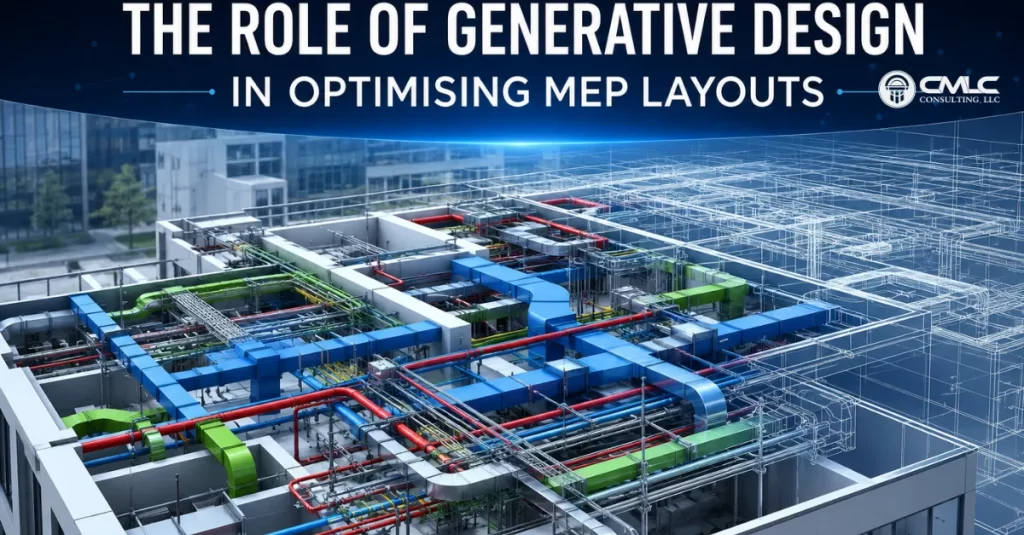
The Role of Generative Design in Optimising MEP Layouts

The Role of Generative Design in Optimising MEP Layouts

The Role of Generative Design in Optimising MEP Layouts

As buildings become more complex and performance‑driven, traditional trial‑and‑error methods for MEP (Mechanical, Electrical, and Plumbing) layout design are no longer sufficient. Today, generative design in MEP BIM is transforming how engineers approach space planning, coordination, energy efficiency, and cost control.

At CMLC Consulting, we integrate generative design workflows with BIM‑based MEP engineering to help clients achieve smarter, clash‑free, and future‑ready building systems. This blog explores how generative design is reshaping MEP layouts—and why it’s becoming a critical advantage for modern construction projects.


What Is Generative Design in MEP?

Generative design is an algorithm‑driven design process where software generates thousands of layout options based on predefined rules such as:

  • Spatial constraints
  • Energy performance targets
  • Material efficiency
  • Maintenance access
  • Local codes and standards

Instead of manually drafting a single MEP layout, engineers evaluate multiple optimised solutions and select the best-performing option.

When combined with MEP BIM services, generative design enables data‑driven decisions early in the design phase—reducing risk, rework, and construction delays.

👉 Learn more about our integrated approach on our MEP BIM Services page.


Key Benefits of Generative Design for MEP Layout Optimisation

1. Faster and Smarter Layout Planning

Generative design automates the exploration of layout possibilities for ductwork, piping, cable trays, and equipment placement. This significantly reduces design time while improving layout quality.

At CMLC Consulting, we use BIM‑based generative workflows to:

  • Optimise routing paths
  • Minimise system overlaps
  • Improve ceiling space utilisation

This approach is especially effective in high‑density environments like hospitals, data centres, and commercial towers.


2. Improved Clash Detection and BIM Coordination

One of the biggest challenges in MEP design is coordination between disciplines. Generative design produces layouts that are coordination‑aware from the start, reducing downstream conflicts.

When paired with BIM coordination services, generative design:

  • Reduces hard and soft clashes
  • Improves interdisciplinary collaboration
  • Minimises RFIs during construction

Explore how we ensure seamless coordination through our BIM Coordination Services.


3. Space and Material Efficiency

Generative algorithms prioritise optimal use of space and materials, helping project teams:

  • Reduce duct and pipe lengths
  • Lower material waste
  • Achieve compact, serviceable layouts

This directly supports cost‑effective construction and sustainability goals.

For accurate cost insights aligned with optimised layouts, CMLC Consulting also provides MEP Cost Estimating Services and MEP Material Take‑Off solutions.


4. Enhanced Energy Performance and Sustainability

Energy efficiency is no longer optional—it’s a core design requirement. Generative design enables simulation‑driven MEP layouts that:

  • Optimise airflow and thermal comfort
  • Reduce pressure drops and energy losses
  • Support green building certifications

By integrating generative outputs with BIM models, CMLC Consulting helps clients design high‑performance, sustainable MEP systems aligned with global best practices.


Generative Design + BIM: A Powerful Combination

Generative design reaches its full potential when combined with end‑to‑end BIM services. At CMLC Consulting, we integrate generative workflows across:

This holistic BIM ecosystem ensures that MEP layouts are not only efficient but also fully coordinated with architectural and structural elements.


Role of Scan to BIM in Generative MEP Design

For renovation and retrofit projects, accurate existing‑condition data is critical. Generative design depends on precise geometry, which is where Scan to BIM becomes invaluable.

CMLC Consulting’s Scan to BIM Services provide:

  • Accurate as‑built BIM models
  • Reliable inputs for generative algorithms
  • Reduced site‑related design risks

This ensures optimised MEP layouts even in complex brownfield projects.


Real‑World Applications Across Building Sectors

Generative design for MEP layouts is widely used across sectors such as:

  • Commercial and office buildings
  • Healthcare facilities
  • Industrial and manufacturing plants
  • Residential high‑rises

You can explore the industries we serve on our Sector page and view our real‑world implementations on the Projects section.


Supporting Teams with BIM & CAD Staffing Solutions

Advanced technologies require skilled professionals. To support clients adopting generative design, CMLC Consulting also offers BIM & CAD Staffing Solutions, providing:

  • Experienced MEP BIM engineers
  • Generative design specialists
  • Scalable project support

This ensures seamless adoption without internal resource strain.


Why Choose CMLC Consulting for Generative MEP Design?

With a strong focus on innovation, coordination, and constructability, CMLC Consulting delivers:

  • Data‑driven MEP optimisation
  • BIM‑enabled generative workflows
  • Cost‑effective and clash‑free designs
  • Global delivery standards

Learn more about our expertise and vision on our About Us page.


Final Thoughts

Generative design is no longer a future concept—it’s a present‑day advantage for MEP engineering. When integrated with BIM, it empowers project teams to design faster, smarter, and more sustainably.

At CMLC Consulting, we combine generative design, BIM expertise, and engineering precision to deliver optimised MEP layouts that perform better throughout the building lifecycle.

📩 Ready to transform your MEP design process?
 Get in touch via our Contact Page or explore our FAQ for quick answers.

Read More
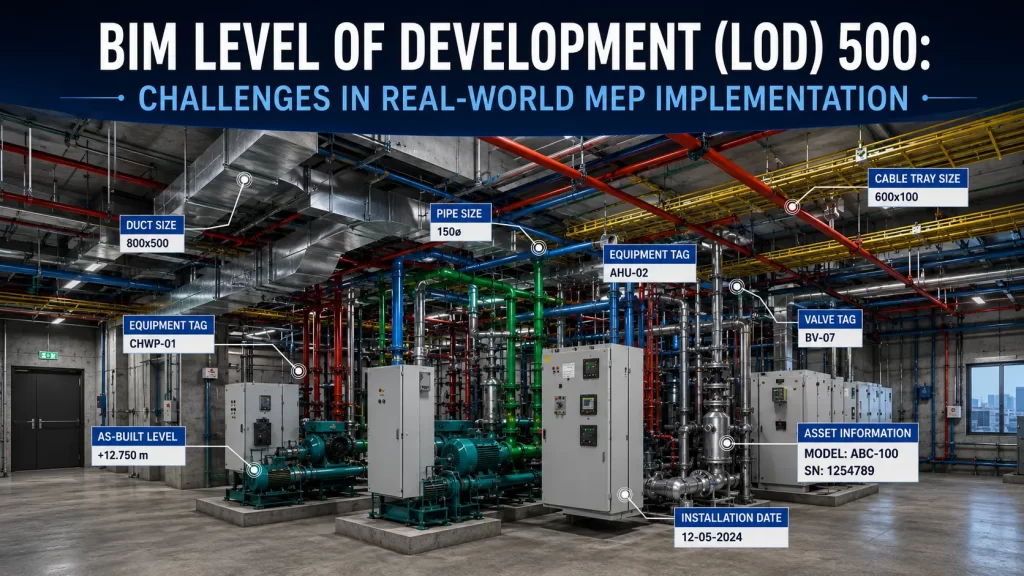
BIM Level of Development (LOD) 500: Challenges in Real‑World MEP Implementation

BIM Level of Development (LOD) 500: Challenges in Real‑World MEP Implementation

BIM Level of Development (LOD) 500: Challenges in Real‑World MEP Implementation

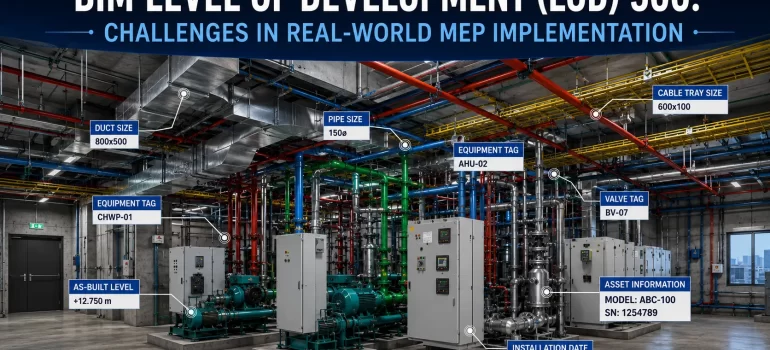
In the evolving world of Building Information Modelling (BIM), LOD 500 represents the highest level of model accuracy—an as‑built digital twin that reflects what has actually been installed on site. While LOD 500 models deliver exceptional value for facilities management and asset lifecycle operations, real‑world MEP implementation at LOD 500 remains one of the most challenging stages of BIM delivery.

At CMLC Consulting, we work closely with contractors, owners, and facility managers to overcome these challenges through advanced MEP BIM services, BIM coordination, and Scan to BIM workflows. This blog explores the key challenges of LOD 500 in MEP systems and how a structured BIM strategy can address them.


Understanding LOD 500 in MEP BIM

LOD 500 models go beyond design intent or construction detailing. They represent:

  • Verified as‑installed conditions
  • Accurate equipment locations and elevations
  • Manufacturer‑specific data
  • Asset tags and maintenance information

For MEP systems, LOD 500 is critical for:

  • Facility management (FM)
  • Operations & maintenance (O&M)
  • Future renovations and retrofits

CMLC Consulting delivers LOD‑specific modelling through its MEP BIM Services, ensuring compliance with project and owner requirements.


Key Challenges in Real‑World LOD 500 MEP Implementation

1. Inaccurate or Incomplete Site Data

One of the biggest hurdles in achieving true LOD 500 is the gap between design models and site reality. Field changes, last‑minute rerouting, and installation constraints often result in discrepancies.

Solution at CMLC Consulting:
 We integrate laser‑scanned data and field verification into BIM workflows using our Scan to BIM Services, ensuring that MEP models accurately reflect real‑world installations.


2. Complex MEP Coordination at As‑Built Stage

MEP systems are densely packed and highly interdependent. At LOD 500, even minor clashes or misalignments can compromise the accuracy of the as‑built model.

Through BIM Coordination Services, CMLC Consulting ensures:

  • Clash‑free as‑built MEP models
  • Cross‑discipline alignment with architectural and structural BIM
  • Validation of final installation conditions

This is especially critical for hospitals, commercial complexes, and industrial facilities.


3. High Data Volume and Information Management

LOD 500 MEP models contain extensive non‑graphical data, including:

  • Equipment serial numbers
  • Manufacturer details
  • Warranty information
  • Maintenance schedules

Managing this information without a structured BIM execution plan can lead to data inconsistency and unusable models.

CMLC Consulting follows industry‑aligned BIM standards across:

This ensures clean, usable, and FM‑ready LOD 500 deliverables.


4. Increased Cost and Time Pressures

Developing LOD 500 models is more resource‑intensive than lower LOD stages. Without accurate quantity and cost alignment, projects may experience budget overruns.

To mitigate this, CMLC Consulting integrates:

These services ensure that as‑built quantities and costs align precisely with installed systems, supporting both contractors and owners.


5. Limited Skilled BIM Resources

LOD 500 requires advanced expertise in:

  • As‑built modelling
  • Field data interpretation
  • BIM‑FM integration

Many organisations struggle with internal skill gaps at this stage.

CMLC Consulting addresses this challenge through BIM & CAD Staffing Solutions, providing experienced MEP BIM professionals who specialise in high‑LOD project delivery.


Importance of LOD 500 for Facility Management

When executed correctly, LOD 500 MEP models become a long‑term asset, enabling:

  • Efficient maintenance planning
  • Faster troubleshooting
  • Reduced lifecycle costs
  • Informed future upgrades

This makes LOD 500 especially valuable across sectors such as healthcare, commercial, industrial, and residential developments—industries we actively support at CMLC Consulting.
 Explore our expertise across markets on the Sector page and see real implementations in our Projects portfolio.


How CMLC Consulting Ensures Successful LOD 500 MEP Delivery

Our approach combines:

  • Accurate Scan to BIM inputs
  • Advanced MEP BIM modelling
  • Rigorous coordination and validation
  • Cost and quantity alignment
  • Skilled BIM staffing support

Learn more about our vision, methodology, and global delivery standards on our About Us page.


Final Thoughts

While LOD 500 MEP implementation presents significant real‑world challenges, it also delivers unmatched long‑term value when executed correctly. With the right combination of technology, expertise, and structured BIM processes, LOD 500 becomes a powerful tool for operational efficiency and asset management.

At CMLC Consulting, we help clients transform complex as‑built data into accurate, reliable, and FM‑ready LOD 500 MEP models.

📩 Have questions about LOD 500 or as‑built BIM requirements?
 Visit our FAQ page or reach out directly via our Contact Us page.

Read More
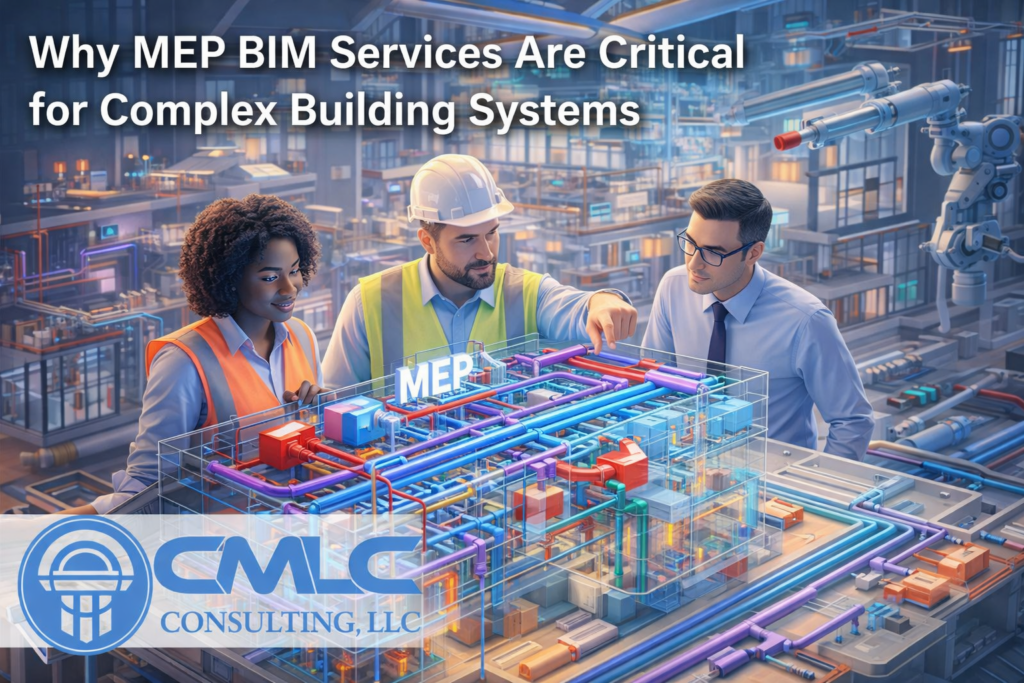
Why MEP BIM Services Are Critical for Complex Building Systems

Why MEP BIM Services Are Critical for Complex Building Systems

Why MEP BIM Services Are Critical for Complex Building Systems

As modern buildings become larger, smarter, and more technically advanced, MEP (Mechanical, Electrical, and Plumbing) systems have grown significantly more complex. Coordinating thousands of components across multiple disciplines—while maintaining accuracy, safety, and efficiency—is nearly impossible with traditional 2D CAD workflows.

This is where MEP BIM Services play a transformative role.

At CMLC Consulting, our
➡️ MEP BIM Services help architects, engineers, contractors, and developers tackle complexity with clarity—ensuring seamless coordination, precise design, and smooth construction execution.


1. Complexity in Modern Buildings Requires Intelligent Modeling

Buildings today include:

  • Smart HVAC systems
  • Renewable energy integrations
  • Dense electrical networks
  • Sophisticated fire protection
  • Plumbing and drainage optimization
  • Building automation systems

Managing these systems with disconnected 2D drawings leads to conflicts, rework, and delays.

MEP BIM brings all systems into one intelligent 3D environment, allowing stakeholders to view, analyze, and coordinate every detail before construction begins.

To support architects and structural teams, CMLC also provides:
➡️ Architectural BIM Services ➡️ Structural BIM Services


2. Precision & Clash Detection Improve Design Accuracy

One of the biggest challenges in MEP-heavy projects is system conflicts:

  • Ducts cutting through beams
  • Conduits blocking pipes
  • Low headroom issues
  • Equipment access clearance clashes

CMLC’s advanced
➡️ BIM Coordination Services identify and eliminate clashes early, ensuring conflict‑free design and construction.

Benefits include:

✔️ Reduced change orders
✔️ Fewer RFIs
✔️ Clear installation paths
✔️ Improved safety and constructability


3. Better Constructability & On-Site Feasibility

Complex buildings demand precise planning. MEP BIM modeling provides real-world constructability insights, such as:

  • Accurate equipment placement
  • Maintenance clearances
  • Installation sequencing
  • Space optimization
  • Modular & prefabrication readiness

CMLC ensures every model meets practical construction standards, lowering risk and improving execution speed.


4. Supporting Prefabrication & Modular Construction

Off-site fabrication is rapidly growing due to cost and time savings.
But prefabrication requires extremely accurate MEP models.

CMLC’s MEP BIM workflows enable:

✔️ Detailed spooling
✔️ Module-ready assemblies
✔️ Fabrication-level modeling
✔️ Optimized routing for pipes, ducts, and conduits

This results in faster installation and reduced manpower on-site.


5. Accurate Quantity Take-offs & Cost Estimation

Complex MEP systems demand precise cost planning. BIM offers automated, data-driven insights.

CMLC provides:
➡️ MEP Cost Estimating Services ➡️ MEP Material Take-Off Services

With BIM-based BOQs, you get:

✔️ Accurate quantities
✔️ Zero manual errors
✔️ Faster budgeting
✔️ Real-time updates when designs change

This is crucial for large-scale hospitals, airports, commercial towers, and industrial facilities.


6. Enhanced Collaboration Across All Disciplines

Complex building projects involve multiple stakeholders. BIM becomes the single source of truth, aligning:

  • Architects
  • Structural engineers
  • MEP consultants
  • Contractors
  • Facility managers

CMLC’s MEP BIM models ensure every stakeholder works with accurate, up-to-date information. For ongoing project support, explore:
➡️ BIM & CAD Staffing Solutions


7. As-Built Accuracy with Scan to BIM

For renovations, retrofits, and expansions, existing building accuracy is critical.
CMLC’s
➡️ Scan to BIM Services capture true site conditions and create detailed MEP as-built models.

This prevents design errors and ensures perfect integration of new systems.


8. Reducing Risk, Delays & Cost Overruns

With tight schedules and high system density, complex projects often face risks such as:

  • Coordination delays
  • Rework
  • Incorrect installations
  • Cost escalations

MEP BIM services by CMLC dramatically reduce these risks through:

✔️ Proactive clash resolution
✔️ Accurate planning
✔️ Visualization-based decision-making
✔️ Early detection of constructability issues


9. Proven Results Across Multiple Sectors

CMLC Consulting has successfully delivered MEP BIM for:
➡️ Hospitality, Healthcare, Industrial, Commercial & Residential Projects See detailed case studies here:
➡️ Our Projects

Our experience across various sectors allows us to adapt MEP BIM solutions to all types of complexity.


Conclusion: MEP BIM Services Are No Longer Optional—They Are Essential

Complex buildings demand precision, coordination, and intelligent planning.
MEP BIM services from CMLC Consulting ensure that every system is accurately designed, highly coordinated, and fully constructible before reaching the site.

With CMLC, you achieve:

✨ Zero clashes
✨ Faster installation
✨ Reduced cost and rework
✨ Better project coordination
✨ High-quality, technically sound MEP design


Ready to Optimize Your Complex Building Project with MEP BIM?

Contact the experts at CMLC Consulting:
➡️ Contact Us

Read More
Reducing MEP Installation Errors with BIM Clash Detection

Reducing MEP Installation Errors with BIM Clash Detection

Reducing MEP Installation Errors with BIM Clash Detection

MEP systems—Mechanical, Electrical, and Plumbing—form the backbone of any building. But they are also the biggest source of installation errors due to their dense routing, cross‑discipline dependencies, and space constraints within ceilings, risers, shafts, and plant rooms.

Traditional 2D drawings often fail to capture these complexities, resulting in unexpected clashes, inaccurate dimensions, and costly site rework.

BIM Clash Detection solves this problem by identifying conflicts early in design, allowing seamless, error‑free MEP installation.

At CMLC Consulting, our advanced
➡️ MEP BIM Services ensure your project is fully coordinated, clash‑free, and installation‑ready.


⭐ Why MEP Installation Errors Occur

MEP installations typically face issues such as:

  • Ducts crossing structural beams
  • Pipes clashing with electrical conduits
  • Sprinklers interfering with lighting layout
  • Incorrect equipment clearance
  • Inconsistent elevation levels
  • Tight ceiling spaces causing routing congestion

These errors often lead to delays, redesigns, increased RFIs, and cost escalation.

BIM Clash Detection eliminates these issues before construction even begins.


How BIM Clash Detection Reduces MEP Installation Errors

Below are the most common installation errors and how CMLC’s BIM workflows prevent them.


1. Preventing Duct, Pipe & Conduit Collisions

❌ Without BIM

Clashes remain hidden until installation begins, forcing crews to re-route systems, causing delays and extra cost.

✔️ With CMLC’s BIM Coordination

CMLC uses Navisworks‑based
➡️ BIM Coordination Services to run automated clash detection across all trades.

Benefits:

  • Zero interference between ducts, pipes, trays, and structures
  • Faster approvals and smoother installation
  • Reduced rework and labor cost

2. Avoiding Incorrect Equipment Placement & Clearance Issues

❌ Common Problem

Equipment such as AHUs, pumps, and panels are installed without proper maintenance space.

✔️ BIM Solution

CMLC embeds manufacturer-specific clearance zones directly into the BIM model.

This ensures:

  • Correct installation sizes
  • Safe maintenance access
  • Compliance with MEP codes and safety standards

3. Eliminating Ceiling Congestion & Routing Conflicts

❌ Without BIM

Ceiling voids often become overcrowded, leading to re-routing on-site and poor workmanship.

✔️ With CMLC’s Expertise

CMLC optimizes layouts by coordinating with:
➡️ Architectural BIM Models ➡️ Structural BIM Models

Results:

  • Smart vertical & horizontal routing
  • Efficient use of ceiling space
  • Zero overlaps during installation

4. Aligning Elevation Levels Across All Trades

❌ The Problem

Even a few centimeters of error can cause installation chaos.

✔️ BIM Fix

CMLC standardizes reference levels using precise 3D alignment checks.
This avoids major installation errors and ensures smoother workflows on-site.


5. Ensuring Code Compliance (Fire, Electrical, Ventilation)

❌ Without Coordination

Sprinklers may be misaligned, electrical conduits can violate clearances, and ventilation paths can get blocked.

✔️ Using BIM

CMLC’s clash detection includes code-based rule checks for:

  • NFPA spacing
  • Electrical safety
  • Fire compartmentation
  • Ventilation standards

This ensures full MEP compliance.


6. Preventing Errors in Renovation Projects

Renovation and retrofit projects face major integration issues between existing and new MEP systems.

✔️ CMLC’s Solution

Accurate as-built modeling using
➡️ Scan to BIM Services eliminates installation errors caused by wrong site assumptions.


7. Reducing Material Wastage & Budget Variations

Incorrect routing or rework directly increases material usage and cost.

✔️ BIM + Quantity Take-offs

CMLC integrates clash-free BIM models with:

➡️ MEP Material Take-Off ➡️ MEP Cost Estimating Services

So your procurement is accurate, optimized, and error-free.


8. Delivering Coordinated Construction Drawings

CMLC provides clear, clash-free:

  • MEP Shop Drawings
  • Sleeve & Penetration Drawings
  • Installation Drawings
  • As-Built Packages

Our in-house team and
➡️ BIM & CAD Staffing Solutions ensure timely documentation for site teams.


9. Reducing RFIs, Change Orders & Delays

With all clashes resolved digitally, construction teams experience:

✨ Fewer RFIs
✨ Faster installation
✨ Minimal disruptions
✨ Zero surprises on-site

Explore similar project outcomes here:
➡️ CMLC Projects ➡️ Sector Expertise


Conclusion: BIM Clash Detection Is the Foundation of Error-Free MEP Installation

MEP installation errors can cripple construction schedules and budgets.
With CMLC Consulting’s BIM Clash Detection, you achieve:

✔️ 100% coordinated MEP systems
✔️ Zero on-site conflicts
✔️ Faster installation
✔️ Lower project risk
✔️ Better safety & compliance
✔️ Predictable costs

CMLC ensures your MEP systems are designed, coordinated, and built with precision.


Want to Reduce MEP Installation Errors in Your Project?

Talk to the BIM experts:
📩 https://cmlcconsulting.com/contact.php
Read More
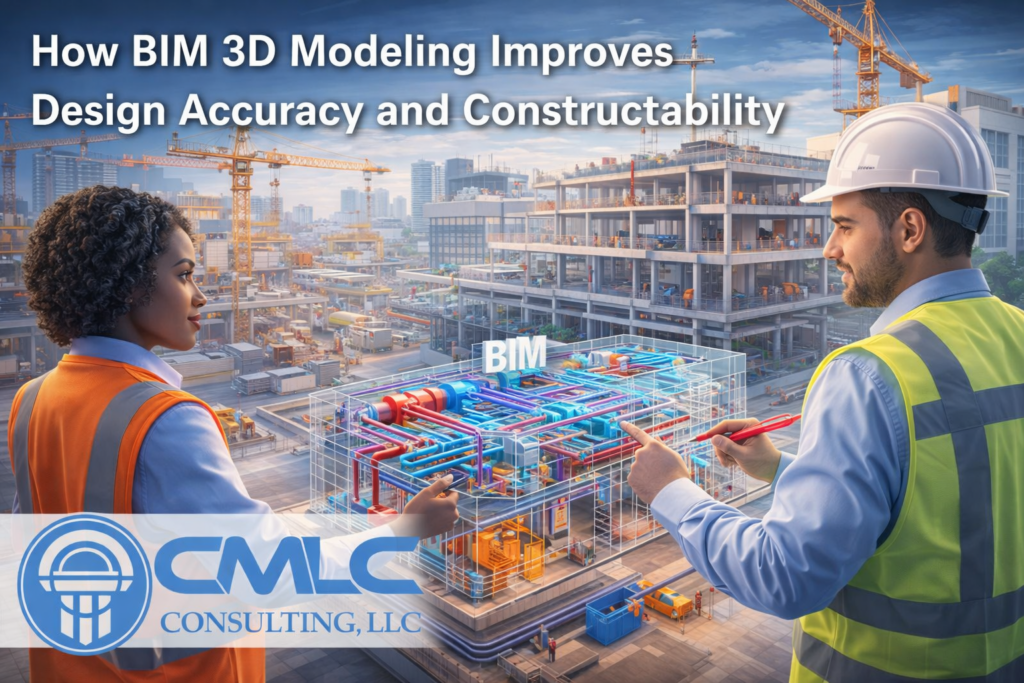
How BIM 3D Modeling Improves Design Accuracy and Constructability

How BIM 3D Modeling Improves Design Accuracy and Constructability

How BIM 3D Modeling Improves Design Accuracy and Constructability

In today’s rapidly evolving AEC industry, BIM 3D Modeling has become a core enabler of precision, collaboration, and efficiency for architects, engineers, and contractors. For complex Mechanical, Electrical, and Plumbing (MEP) systems, accuracy is non‑negotiable—because even a minor clash or design discrepancy can result in costly rework, delays, and material wastage.

At CMLC Consulting, our specialized
➡️ MEP BIM Services are designed to enhance design accuracy, streamline coordination, and significantly improve constructability across all project stages.


1. Enhanced Design Accuracy with BIM 3D Modeling

Traditional 2D drawings often lead to misinterpretations, inconsistencies, and coordination gaps. BIM 3D modeling solves these challenges by offering an information‑rich, visually precise representation of all building systems.

Key advantages that BIM 3D modeling brings to design accuracy:

✔️ Clash‑free and coordinated models

Using BIM, design teams can detect and resolve clashes before construction begins. CMLC’s
➡️ BIM Coordination Services ensure MEP systems are fully synchronized with architectural and structural components.

✔️ Accurate dimensions, geometry & component placement

Every model element is created with manufacturer‑level detail, reducing discrepancies between design and site execution.

✔️ Consistency across disciplines

Shared BIM models ensure that architects, structural engineers, and MEP teams are always aligned. Explore CMLC’s
➡️ Architectural BIM Services ➡️ Structural BIM Services for integrated workflows.


2. Improving Constructability Through BIM

Constructability is all about ensuring designs are practical, feasible, and conflict‑free during real-world execution. BIM 3D Modeling significantly boosts constructability for MEP systems.

Here’s how:

✔️ Realistic installation sequencing

3D models enable contractors to visualize installation stages, improving planning and reducing rework.

✔️ Optimized routing for MEP systems

BIM helps define efficient paths for ducts, pipes, cable trays, and equipment, maximizing available space.

✔️ Pre‑fabrication and modularization

Since BIM delivers precise sizing and layouts, MEP components can be prefabricated off‑site—saving time and cost.

✔️ Accurate quantity take‑offs and cost estimates

CMLC provides
➡️ MEP Material Take‑Off ➡️ MEP Cost Estimating Services to ensure accurate budgeting and resource planning.


3. Reducing Risks, Delays, and Rework

By detecting clashes early and improving design clarity, BIM prevents cost overruns and project delays. Contractors benefit from:

  • Safer installation sequences
  • Clearer documentation
  • Fewer RFIs
  • Streamlined site coordination

CMLC’s experience delivering projects across multiple sectors (view our
➡️ Projects and
➡️ Sector Expertise)
ensures that potential risks are mitigated right from the modeling stage.


4. Improved Collaboration & Project Transparency

BIM creates a single source of truth for all stakeholders. With CMLC’s expert modeling and coordination:

  • Architects understand system constraints
  • Engineers avoid conflicts
  • Contractors execute with confidence

CMLC also supports teams through
➡️ BIM & CAD Staffing Solutions for large‑scale, ongoing BIM project demands.


5. Scan to BIM for As‑Built Accuracy

For renovation or expansion projects, accurate as‑built data is essential. CMLC offers
➡️ Scan to BIM Services to convert laser scans into highly accurate BIM models, ensuring perfect fit-out and smooth system integration.


Conclusion

BIM 3D Modeling has completely transformed design accuracy and constructability in MEP engineering. With CMLC Consulting’s dedicated BIM expertise, clients experience:

✨ Fewer clashes
✨ Better design decisions
✨ Faster installation
✨ Reduced project cost
✨ Improved collaboration

Whether you’re a contractor, architect, or engineering firm, CMLC supports you with end‑to‑end BIM solutions tailored to your project’s needs.


Want to Improve Design Accuracy & Constructability with BIM?

📩 Let’s discuss your project today:
➡️ Contact CMLC Consulting

Read More
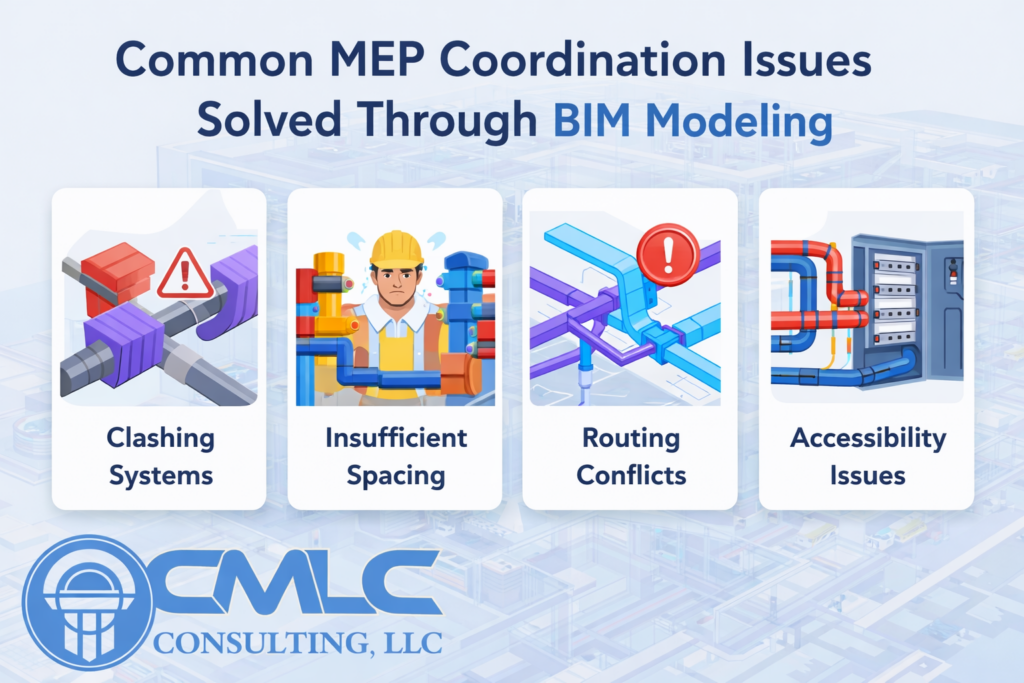
Common MEP Coordination Issues Solved Through BIM Modeling

Common MEP Coordination Issues Solved Through BIM Modeling

Modern construction projects are becoming increasingly complex, with tight timelines, dense building systems, and high demands for accuracy. Among all building disciplines, MEP (Mechanical, Electrical, and Plumbing) systems are the most difficult to coordinate due to their extensive routing, spatial requirements, and interdependencies with structural and architectural elements.

This is where BIM Modeling—especially MEP BIM—revolutionizes project delivery.

At CMLC Consulting, our
➡️ MEP BIM Services resolve coordination challenges early, ensuring seamless installation, reduced rework, and improved construction quality.


⭐ Why MEP Coordination Problems Happen

Most issues arise because traditional workflows rely on siloed drawings and assumptions. Without unified coordination, different trades design independently, leading to:

  • Spatial conflicts
  • Route congestion
  • Misaligned levels
  • Inaccurate clearances
  • Late‑stage site changes

BIM Modeling eliminates these issues by combining all disciplines into a single, intelligent 3D environment.

Below are the most common MEP coordination problems, and how CMLC solves them through BIM.


1. Duct, Pipe & Conduit Clashes with Structure

❌ Common Problem:

  • Ducts running through beams
  • Pipes interfering with slabs
  • Conduits intersecting structural walls

These structural-MEP conflicts cause costly rework and delays once discovered on‑site.

✔️ BIM Solution from CMLC:

CMLC’s
➡️ BIM Coordination Services perform clash detection using industry standards & LOD guidelines, resolving conflicts before construction.

Benefits:

  • Zero structural violations
  • Faster approvals
  • Improved structural integrity

2. Congested MEP Routing in Ceiling & Shaft Space

❌ Common Problem:

MEP systems often fight for limited space in ceilings, risers, and shafts—creating routing conflicts.

✔️ BIM Solution from CMLC:

Through discipline-wise color coding, elevation control, and optimized routing, CMLC ensures:

  • Efficient duct, pipe, and cable tray distribution
  • Feasible installation sequences
  • Maximum use of available space

Our integrated modeling approach aligns all systems with:
➡️ Architectural BIM Models ➡️ Structural BIM Models


3. Improper Equipment Placement & Access Clearance Issues

❌ Common Problem:

Equipment like AHUs, pumps, panels, chillers, and transformers often fail clearance and maintenance checks.

✔️ BIM Solution from CMLC:

We embed manufacturer clearances directly into BIM models, ensuring:

  • Sufficient service access
  • Safe equipment installation
  • Compliance with safety codes

4. Level Misalignment Between Trades

❌ Common Problem:

Inconsistent elevation data creates thousands of conflicts during installation.

✔️ BIM Solution from CMLC:

CMLC standardizes levels, reference planes, and base points across all trade models to eliminate misalignment.


5. Fire Safety & Code Compliance Issues

❌ Common Problem:

  • Incorrect spacing of sprinklers
  • Inaccurate fire-rating coordination
  • Blocked egress pathways

✔️ BIM Solution from CMLC:

Our MEP BIM experts analyze code-driven requirements to ensure:

  • NFPA-compliant layout
  • Correct fire zonation
  • Safe and accessible pathways

6. Poor Integration Between Existing & New Systems

This is a major challenge in renovation or extension projects.

✔️ BIM Solution from CMLC:

With
➡️ Scan to BIM Services we convert point clouds into precise as‑built models—giving accurate visibility of existing conditions.

Outcome:
No surprises on-site. Perfect integration between old and new systems.


7. Material Miscalculations & Budget Variations

❌ Common Problem:

Manual BOQs lead to wrong quantities, unpredictable costs, and procurement delays.

✔️ BIM Solution from CMLC:

Our automated, data-driven workflows include:
➡️ MEP Material Take-Off  ➡️ MEP Cost Estimating Services

Results:

  • Accurate quantities
  • Controlled budgets
  • Faster procurement

8. Inconsistent Documentation Across Trades

✔️ BIM Solution from CMLC:

We deliver clean, coordinated, and ready-to-build drawings:

  • Shop Drawings
  • Installation Drawings
  • Sleeve & Penetration Drawings
  • As-Built Documentation

Supported by multi-disciplinary BIM & CAD teams:
➡️ BIM & CAD Staffing Solutions


9. On-Site Rework, Delays & RFI Overload

✔️ BIM Solution from CMLC:

With early clash detection, constructability reviews, and coordinated BIM models, CMLC helps you minimize:

  • RFIs
  • Change orders
  • On-site delays
  • Costly rework

Browse CMLC’s real project results:
➡️ Projects Delivered  ➡️ Sector Expertise


Conclusion: BIM Modeling Is the Ultimate Solution for MEP Coordination

MEP coordination is one of the most challenging aspects of building construction.
With BIM-driven design, CMLC Consulting ensures:

✨ Fully coordinated models
✨ No clashes or installation conflicts
✨ Code-compliant MEP layouts
✨ Accurate BOQs & cost control
✨ Faster project delivery
✨ Reduced site risks


Need BIM Support for Your Project?

Let the experts at CMLC Consulting streamline your next project.

📩 Contact us today:
➡️ https://cmlcconsulting.com/contact.php
Read More
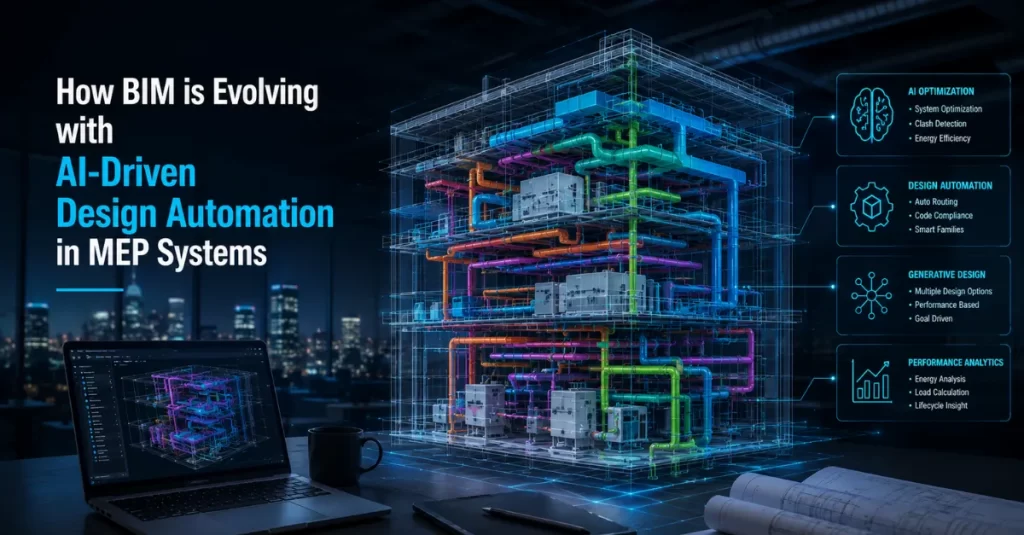
How BIM Is Evolving with AI‑Driven Design Automation in MEP Systems

How BIM Is Evolving with AI‑Driven Design Automation in MEP Systems

How BIM Is Evolving with AI‑Driven Design Automation in MEP Systems

The Architecture, Engineering, and Construction (AEC) industry is witnessing a paradigm shift as Artificial Intelligence (AI) begins to redefine how Building Information Modelling (BIM) is applied—especially within MEP (Mechanical, Electrical, and Plumbing) systems. What was once a coordination and documentation tool is now transforming into a design intelligence platform capable of automation, optimisation, and predictive decision‑making.

At CMLC Consulting, this evolution is not theoretical—it is actively shaping how we deliver future‑ready BIM solutions to global clients.


The Traditional Challenges of MEP BIM Design

MEP systems are the most complex and coordination‑intensive components of any building. Conventional BIM workflows often struggle with:

  • Repetitive manual modelling tasks
  • Late‑stage clash detection
  • Design inefficiencies due to rule‑based constraints
  • Limited performance optimisation during early design stages

Even with advanced MEP BIM Services, these challenges can result in cost overruns, design delays, and rework if not addressed early.

👉 This is where AI‑driven design automation is redefining BIM’s role.


What Is AI‑Driven Design Automation in MEP BIM?

AI‑driven BIM integrates machine learning algorithms, generative design, and rule‑based automation directly into MEP workflows. Instead of designers manually testing design options, AI evaluates thousands of possibilities based on:

  • Building geometry
  • Load requirements
  • Energy efficiency targets
  • Code compliance
  • Material and cost constraints

The result is smarter, faster, and optimised MEP system design.

CMLC Consulting leverages these capabilities within our advanced
 MEP BIM Services to support consultants, contractors, and developers worldwide.


Key Ways AI Is Transforming MEP BIM Workflows

1. Automated MEP Layout Generation

AI algorithms can automatically generate ducting, piping, and cable tray layouts based on spatial constraints and engineering rules. This significantly reduces modelling time while improving accuracy.

When integrated with BIM Coordination Services, automated layouts also minimise clashes across architectural and structural models.


2. Intelligent Clash Prediction (Not Just Detection)

Traditional BIM detects clashes after modelling. AI predicts clashes before they occur by learning from historical coordination data.

This proactive approach aligns perfectly with CMLC Consulting’s multi‑disciplinary coordination expertise across
 Architectural BIM Services and
 Structural BIM Services.


3. Energy & Performance‑Optimised MEP Design

AI enables performance‑based design automation, allowing MEP systems to be optimised for:

  • Energy efficiency
  • HVAC load balancing
  • Water usage optimisation
  • Sustainability compliance

This supports smarter early‑stage decisions and improves long‑term building performance—especially critical in commercial and healthcare sectors.

Explore how CMLC supports data‑driven projects across sectors here:
 👉 Sectors We Serve


4. AI‑Powered Cost Estimation & Quantity Automation

One of the biggest advantages of AI in MEP BIM is real‑time cost intelligence. Automated take‑offs and predictive costing allow teams to understand budget impacts instantly.

CMLC Consulting integrates BIM automation with:

This ensures accuracy, transparency, and faster procurement decisions.


5. Scan‑to‑BIM Meets AI for Retrofit Projects

For renovation and retrofit projects, AI enhances Scan‑to‑BIM by automatically classifying point‑cloud data and recognising MEP components.

Our Scan to BIM Services enable faster conversion of existing conditions into intelligent BIM models—ideal for brownfield developments and facility upgrades.


The Role of Skilled BIM Professionals in an AI‑Driven Future

While AI automates repetitive tasks, human expertise remains critical for:

  • Engineering judgement
  • Compliance validation
  • Custom project constraints
  • Client‑specific design standards

CMLC Consulting bridges this gap through flexible
 BIM & CAD Staffing Solutions—ensuring organisations have access to AI‑ready BIM professionals without long‑term overheads.


Real‑World Impact: Faster Delivery, Lower Risk, Higher ROI

Projects leveraging AI‑driven MEP BIM workflows consistently achieve:

✅ Reduced design cycles
 ✅ Fewer RFIs and site clashes
 ✅ Optimised system performance
 ✅ Lower lifecycle costs

You can explore how CMLC Consulting delivers such outcomes across global projects here:
 👉 Our Projects


Why CMLC Consulting Is at the Forefront of AI‑Enabled BIM

At CMLC Consulting, we don’t just follow BIM trends—we operationalise them. Our approach combines:

  • Proven BIM standards
  • AI‑enabled automation workflows
  • Cross‑disciplinary coordination
  • Cost and constructability intelligence

Learn more about our vision and expertise here:
 👉 About CMLC Consulting


Final Thoughts: The Future of MEP BIM Is Intelligent

AI‑driven design automation is no longer optional—it is becoming a competitive necessity. Firms that adopt intelligent BIM workflows today will lead the industry tomorrow.

If you’re looking to future‑proof your MEP design and construction processes, CMLC Consulting is your trusted BIM partner.

📩 Get in touch with our BIM experts today:
 👉 Contact CMLC Consulting

Read More
Digital Twins in Building Lifecycle Management: Beyond BIM Models

Digital Twins in Building Lifecycle Management: Beyond BIM Models

Digital Twins in Building Lifecycle Management: Beyond BIM Models

As the construction industry accelerates towards data‑driven decision‑making, Digital Twins are emerging as the next evolution of Building Information Modelling (BIM). While BIM has transformed how buildings are designed and coordinated, Digital Twins take this a step further—enabling real‑time performance monitoring, predictive maintenance, and lifecycle optimisation.

At CMLC Consulting, Digital Twins are not viewed as a replacement for BIM, but as its natural progression across the entire building lifecycle.


From BIM Models to Living Digital Twins

Traditional BIM models provide a static representation of a building—geometry, quantities, and coordinated systems frozen at a point in time. Digital Twins, however, are dynamic, intelligent replicas that evolve alongside the physical asset.

A Digital Twin integrates:

  • BIM data
  • IoT sensor inputs
  • Operational and maintenance data
  • Energy and performance analytics

This transformation allows stakeholders to manage buildings from design to demolition using a single, intelligent data environment.

CMLC Consulting builds this foundation through robust

👉 Architectural BIM Services and

👉 Structural BIM Services

ensuring Digital Twins are accurate, reliable, and future‑ready.


Why Digital Twins Matter in Building Lifecycle Management

Digital Twins extend value far beyond design and construction, offering measurable benefits across every project phase:

✅ Design & Planning

  • Scenario‑based simulations
  • Performance‑driven design decisions
  • Clash‑free, optimised layouts

✅ Construction

  • Real‑time progress tracking
  • Reduced RFIs and rework
  • Enhanced BIM coordination

✅ Operations & Facilities Management

  • Predictive maintenance
  • Energy consumption optimisation
  • Asset performance monitoring

✅ Renovation & Retrofit

  • Data‑backed refurbishment strategies
  • Faster decision‑making using existing asset intelligence

CMLC Consulting supports these workflows through advanced

👉 BIM Coordination Services that ensure all disciplines contribute to a unified digital ecosystem.


The Role of MEP Systems in Digital Twins

MEP systems are the heartbeat of any Digital Twin. HVAC performance, electrical loads, plumbing efficiency, and fire protection systems generate the most valuable operational data.

By integrating Digital Twins with intelligent MEP BIM, project teams can:

  • Monitor real‑time HVAC efficiency
  • Predict system failures before they occur
  • Reduce energy consumption and carbon footprint

CMLC Consulting delivers this intelligence through industry‑leading

👉 MEP BIM Services

supported by data‑driven engineering workflows.


Scan‑to‑BIM: The Gateway to Digital Twins for Existing Buildings

For existing assets, Digital Twins begin with accurate reality capture. Scan‑to‑BIM converts laser scans and point clouds into information‑rich BIM models that act as the digital foundation.

Our

👉 Scan to BIM Services

enable building owners to unlock Digital Twin capabilities for:

  • Old commercial buildings
  • Healthcare facilities
  • Industrial plants
  • Infrastructure assets

This is especially critical for retrofit, renovation, and facility management projects.


Cost Intelligence & Asset Optimisation with Digital Twins

One of the most powerful advantages of Digital Twins is continuous cost visibility. When integrated with BIM‑based cost data, Digital Twins enable:

  • Lifecycle cost forecasting
  • Real‑time budget impact analysis
  • Smarter procurement and maintenance planning

CMLC Consulting strengthens this capability through:

This ensures Digital Twins deliver financial intelligence, not just visual data.


Digital Twins Across Industry Sectors

Digital Twins are transforming how buildings operate across multiple sectors, including:

  • Commercial & Mixed‑Use Developments
  • Healthcare & Hospitals
  • Data Centres
  • Industrial & Manufacturing Facilities
  • Infrastructure Projects

Explore how CMLC Consulting applies BIM and Digital Twin strategies across sectors:

👉 Industries & Sectors We Serve


People Still Matter: BIM Expertise Behind Digital Twins

While Digital Twins rely on automation and analytics, they still require high‑quality BIM inputs and engineering expertise. Skilled professionals ensure data accuracy, system logic, and compliance with project standards.

CMLC Consulting supports organisations with flexible

👉 BIM & CAD Staffing Solutions

providing experienced BIM professionals who understand both design intelligence and operational data workflows.


Real‑World Digital Twin Success Starts with the Right BIM Partner

Successful Digital Twins are built on:

  • Accurate BIM models
  • Coordinated multi‑disciplinary data
  • Scalable information structures
  • Long‑term lifecycle thinking

CMLC Consulting has delivered BIM‑driven outcomes across global projects—view our experience here:

👉 Our BIM Projects


Why Choose CMLC Consulting for Digital Twin‑Ready BIM?

At CMLC Consulting, we help clients move beyond static BIM models by delivering:

  • Lifecycle‑oriented BIM strategies
  • Digital Twin‑ready data structures
  • MEP‑focused performance intelligence
  • Scalable solutions for future technologies

Learn more about our vision and expertise:

👉 About CMLC Consulting


Final Thoughts: Digital Twins Are the Future of Smart Buildings

Digital Twins represent the future of intelligent, responsive, and sustainable buildings. As BIM continues to evolve, organisations that embrace Digital Twins today will gain long‑term operational, financial, and environmental advantages.

If you’re ready to transform your BIM data into a living digital asset, CMLC Consulting is your trusted partner.

📩 Talk to our BIM & Digital Twin experts today:

👉 Contact CMLC Consulting

Read More
What Is BIM Modeling and Why It’s Essential for Modern Construction Projects?

What Is BIM Modeling and Why It’s Essential for Modern Construction Projects?

What Is BIM Modeling and Why It’s Essential for Modern Construction Projects?

In today’s fast‑evolving construction landscape, precision, collaboration, and efficiency determine the success of a project. Building Information Modeling (BIM) has emerged as a game‑changing technology that transforms how architects, engineers, contractors, and facility managers plan, design, and execute construction projects.

At CMLC Consulting, we specialize in delivering accurate, high‑quality BIM services that support seamless project execution—from design to handover. Whether it’s Architectural BIM, Structural BIM, or MEP BIM, our solutions help clients reduce costs, mitigate risks, and boost overall project efficiency.


What Is BIM Modeling?

BIM (Building Information Modeling) is a digital representation of the physical and functional characteristics of a building. Unlike traditional 2D drawings, BIM creates an intelligent 3D model that includes detailed information about materials, geometry, components, and systems.

BIM is far more than a visual model—it’s a data‑rich platform that enables stakeholders to collaborate throughout the entire project lifecycle.

BIM Supports:

✔ Design & Visualization
✔ Coordination between disciplines
✔ Quantity take-offs
✔ Clash detection
✔ Scheduling (4D)
✔ Cost estimation (5D)
✔ Facility management (6D)

To explore our specialized BIM offerings, visit:
🔗 Architectural BIM Services
🔗 Structural BIM Services
🔗 MEP BIM Services


Why BIM Is Essential for Modern Construction Projects

1. Enhanced Collaboration and Coordination

One of the biggest challenges in construction is miscommunication between teams. BIM centralizes all design data into a single shared model.

At CMLC, our BIM Coordination Services help teams detect issues early, ensuring a smooth and coordinated workflow.

Benefits:

  • Fewer design conflicts
  • Real-time collaboration
  • Improved project transparency

2. Reduced Costs and Rework

Rework can account for up to 30% of construction costs. BIM drastically reduces errors by ensuring all layouts and systems fit perfectly before construction begins.

Our MEP BIM models and clash detection workflows minimize on-site issues, saving time and money.

🔗 Explore: MEP BIM Services


3. Accurate Material Quantities & Cost Estimation

Traditional quantity estimation is prone to human error, but BIM automates the process, providing incredibly accurate take-offs.

CMLC supports contractors and developers through:
🔗 MEP Cost Estimating Services
🔗 MEP Material Take-Off

Benefits:

  • Accurate BOQs
  • Better budget management
  • Reduced material waste

4. Better Visualization for Smarter Decision‑Making

3D visualization helps stakeholders understand the project clearly at every stage. This makes design review and approval much faster.

CMLC leverages cutting-edge tools to create detailed and realistic BIM models for flawless execution.


5. Improved Construction Efficiency

BIM enhances planning by integrating time (4D) and cost (5D) information. This ensures better scheduling, resource allocation, and site safety.


6. Supports Renovation & Restoration with Scan to BIM

For existing structures, BIM becomes even more essential. Our Scan to BIM Services convert point cloud data into accurate, as-built BIM models.

Ideal for:

  • Renovations
  • Facility upgrades
  • Heritage preservation

7. Stronger Workforce Through BIM‑CAD Staffing Solutions

Modern construction requires skilled BIM professionals.
CMLC supports firms through:
🔗 BIM & CAD Staffing Solutions

This ensures you have the right talent for even the most complex projects.


How CMLC Consulting Adds Value to Construction Projects

CMLC is a trusted BIM partner for architects, contractors, engineers, and developers. We combine advanced technology with highly skilled teams to deliver accurate, coordinated, and compliant BIM models.

Explore our expertise and past work:
🔗 Projects
🔗 Sectors We Serve
🔗 About Us
🔗 FAQs

For enquiries or collaborations:
🔗 Contact Us


Conclusion

BIM is no longer optional—it’s essential for modern construction. From improving accuracy and reducing costs to enhancing collaboration and enabling smarter decision‑making, BIM redefines how buildings are planned and delivered.

CMLC Consulting ensures your projects are future‑ready with best-in-class BIM services tailored to your needs.

Read More