
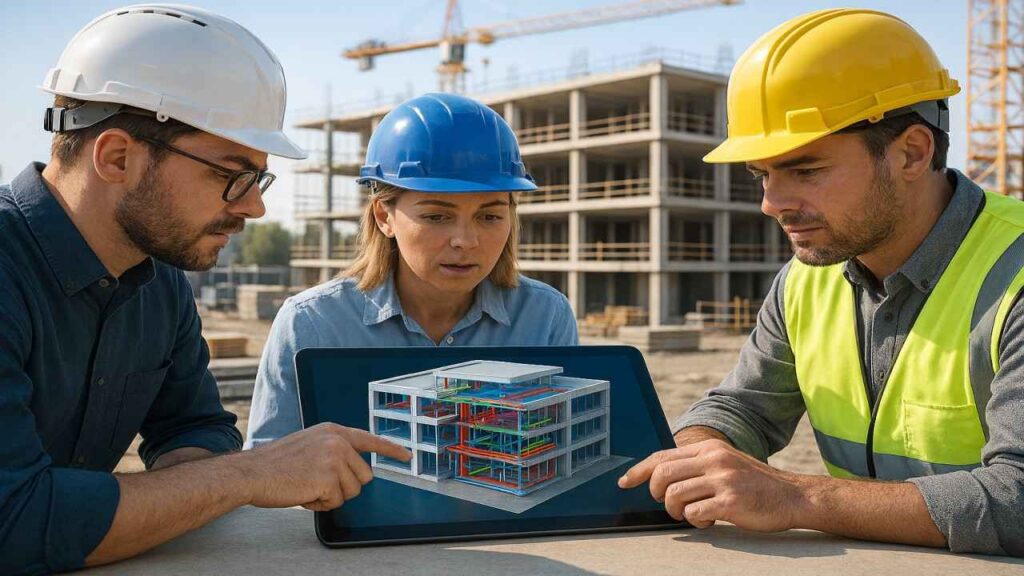
In today’s increasingly complex construction environment, smooth collaboration among architects, engineers, and contractors is essential for delivering projects on time, within budget, and with fewer errors. By 2026, BIM (Building Information Modeling) has evolved into a powerful, integrated ecosystem that eliminates fragmentation, fosters real‑time collaboration, and ensures all stakeholders work from the same source of truth. Here’s how BIM services are transforming project coordination across the AEC (Architecture, Engineering, Construction) industry.
1. BIM Centralizes Project Data Into a Unified Source of Truth
Traditional construction workflows relied on siloed documentation—multiple versions of drawings, disconnected updates, and fragmented communication. BIM changes this entirely.
- BIM provides a single, integrated digital model that connects design, scheduling, procurement, execution, and operations, eliminating data silos.
- It creates a Common Data Environment (CDE) where architects, engineers, and contractors access synchronized, up‑to‑date project information.
This centralization reduces misunderstandings and ensures all disciplines maintain alignment throughout the project lifecycle.
2. Real‑Time Collaboration Enhances Transparency & Reduces Delays
One of BIM’s most powerful contributions is enabling multidisciplinary teams to collaborate live on the same model.
- Cloud-based BIM platforms allow teams to work simultaneously on shared models regardless of geography, supporting real‑time updates and eliminating outdated file exchanges.
- Over half of new construction projects in 2026 now use real‑time cloud model collaboration, significantly reducing coordination errors.
- Stakeholders can instantly see design changes, improving transparency, trust, and response times.
This live co-authoring dramatically improves communication speed between architects (design intent), engineers (technical feasibility), and contractors (constructability).
3. Early Clash Detection Minimizes Rework and Cost Overruns
Clash detection is one of the most valuable BIM services for cross-disciplinary coordination.
- BIM enables early identification of conflicts between architectural, structural, and MEP systems, long before construction begins.
- Projects using comprehensive BIM coordination have seen up to 40% fewer RFIs and 25% reduction in change orders, demonstrating its impact on reducing rework.
By resolving design inconsistencies at the digital stage, BIM helps teams avoid costly field errors and redesign cycles.
4. Enhanced Communication Through Data‑Rich 3D Models
BIM models aren’t just visual—they contain detailed material specs, dimensions, performance data, and more.
- Data-rich elements support informed decision‑making with accurate specifications, scheduling data, and performance analysis.
- Visualizing 3D models improves clarity between architects (design), engineers (system placement), and contractors (installation feasibility).
- Interactive visualization reduces misinterpretations that commonly occur with 2D drawings.
This shared visual language bridges communication gaps and enhances comprehension across roles.
5. Cloud‑Enabled Access Supports On‑Site and Remote Teams
Modern BIM services extend beyond office desktops.
- Contractors can access the most current BIM model directly on-site, ensuring construction follows the latest design intent.
- Cloud-based BIM creates continuous, traceable data environments, reducing errors caused by outdated files or version confusion.
Everyone—from design studios to field teams—stays aligned from start to finish.
6. Seamless Coordination Strengthens Trust and Reduces Project Risks
Poor coordination can lead to disputes, delays, and rework. BIM mitigates these challenges by:
- Providing transparency into decisions, updates, and responsibilities.
- Reducing communication gaps that traditionally slow down projects between architects and contractors.
- Offering a unified collaboration platform that prevents misalignment and reduces schedule disruptions.
When teams trust the information they rely on, coordination becomes significantly smoother.
Conclusion: BIM Is the Backbone of Modern AEC Coordination
By 2026, BIM has matured into a collaborative project operating system that enhances coordination at every stage of a building’s lifecycle. Through centralized data, real‑time teamwork, intelligent clash detection, and transparent communication, BIM services ensure architects, engineers, and contractors operate in perfect sync.
The result?
✔ Fewer errors
✔ Faster decision‑making
✔ Higher-quality construction
✔ Stronger stakeholder alignment
BIM isn’t just improving coordination—it’s redefining how the AEC industry works together.