
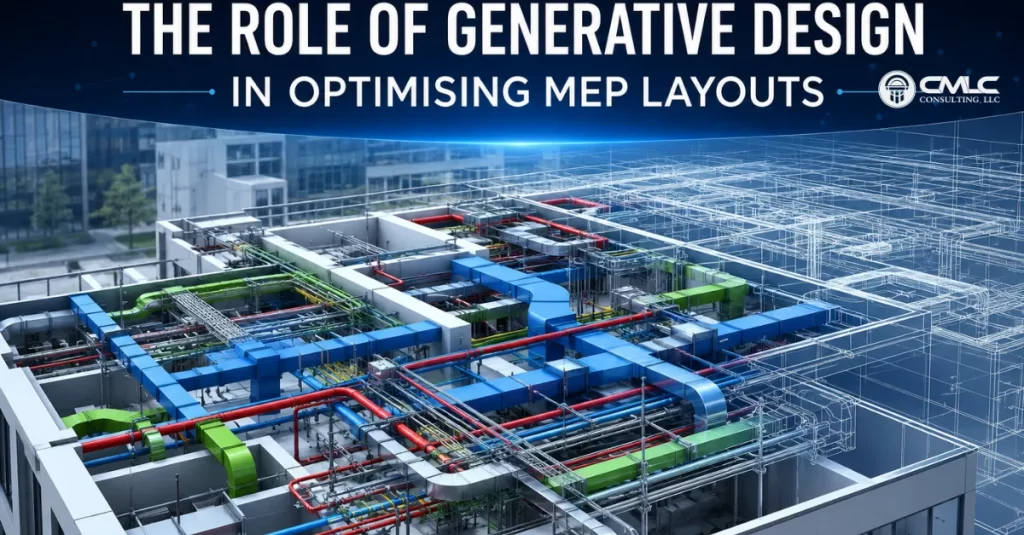
As buildings become more complex and performance‑driven, traditional trial‑and‑error methods for MEP (Mechanical, Electrical, and Plumbing) layout design are no longer sufficient. Today, generative design in MEP BIM is transforming how engineers approach space planning, coordination, energy efficiency, and cost control.
At CMLC Consulting, we integrate generative design workflows with BIM‑based MEP engineering to help clients achieve smarter, clash‑free, and future‑ready building systems. This blog explores how generative design is reshaping MEP layouts—and why it’s becoming a critical advantage for modern construction projects.
What Is Generative Design in MEP?
Generative design is an algorithm‑driven design process where software generates thousands of layout options based on predefined rules such as:
- Spatial constraints
- Energy performance targets
- Material efficiency
- Maintenance access
- Local codes and standards
Instead of manually drafting a single MEP layout, engineers evaluate multiple optimised solutions and select the best-performing option.
When combined with MEP BIM services, generative design enables data‑driven decisions early in the design phase—reducing risk, rework, and construction delays.
👉 Learn more about our integrated approach on our MEP BIM Services page.
Key Benefits of Generative Design for MEP Layout Optimisation
1. Faster and Smarter Layout Planning
Generative design automates the exploration of layout possibilities for ductwork, piping, cable trays, and equipment placement. This significantly reduces design time while improving layout quality.
At CMLC Consulting, we use BIM‑based generative workflows to:
- Optimise routing paths
- Minimise system overlaps
- Improve ceiling space utilisation
This approach is especially effective in high‑density environments like hospitals, data centres, and commercial towers.
2. Improved Clash Detection and BIM Coordination
One of the biggest challenges in MEP design is coordination between disciplines. Generative design produces layouts that are coordination‑aware from the start, reducing downstream conflicts.
When paired with BIM coordination services, generative design:
- Reduces hard and soft clashes
- Improves interdisciplinary collaboration
- Minimises RFIs during construction
Explore how we ensure seamless coordination through our BIM Coordination Services.
3. Space and Material Efficiency
Generative algorithms prioritise optimal use of space and materials, helping project teams:
- Reduce duct and pipe lengths
- Lower material waste
- Achieve compact, serviceable layouts
This directly supports cost‑effective construction and sustainability goals.
For accurate cost insights aligned with optimised layouts, CMLC Consulting also provides MEP Cost Estimating Services and MEP Material Take‑Off solutions.
4. Enhanced Energy Performance and Sustainability
Energy efficiency is no longer optional—it’s a core design requirement. Generative design enables simulation‑driven MEP layouts that:
- Optimise airflow and thermal comfort
- Reduce pressure drops and energy losses
- Support green building certifications
By integrating generative outputs with BIM models, CMLC Consulting helps clients design high‑performance, sustainable MEP systems aligned with global best practices.
Generative Design + BIM: A Powerful Combination
Generative design reaches its full potential when combined with end‑to‑end BIM services. At CMLC Consulting, we integrate generative workflows across:
- Architectural BIM Services for spatial planning
- Structural BIM Services for constructability validation
- MEP BIM modelling for system optimisation
This holistic BIM ecosystem ensures that MEP layouts are not only efficient but also fully coordinated with architectural and structural elements.
Role of Scan to BIM in Generative MEP Design
For renovation and retrofit projects, accurate existing‑condition data is critical. Generative design depends on precise geometry, which is where Scan to BIM becomes invaluable.
CMLC Consulting’s Scan to BIM Services provide:
- Accurate as‑built BIM models
- Reliable inputs for generative algorithms
- Reduced site‑related design risks
This ensures optimised MEP layouts even in complex brownfield projects.
Real‑World Applications Across Building Sectors
Generative design for MEP layouts is widely used across sectors such as:
- Commercial and office buildings
- Healthcare facilities
- Industrial and manufacturing plants
- Residential high‑rises
You can explore the industries we serve on our Sector page and view our real‑world implementations on the Projects section.
Supporting Teams with BIM & CAD Staffing Solutions
Advanced technologies require skilled professionals. To support clients adopting generative design, CMLC Consulting also offers BIM & CAD Staffing Solutions, providing:
- Experienced MEP BIM engineers
- Generative design specialists
- Scalable project support
This ensures seamless adoption without internal resource strain.
Why Choose CMLC Consulting for Generative MEP Design?
With a strong focus on innovation, coordination, and constructability, CMLC Consulting delivers:
- Data‑driven MEP optimisation
- BIM‑enabled generative workflows
- Cost‑effective and clash‑free designs
- Global delivery standards
Learn more about our expertise and vision on our About Us page.
Final Thoughts
Generative design is no longer a future concept—it’s a present‑day advantage for MEP engineering. When integrated with BIM, it empowers project teams to design faster, smarter, and more sustainably.
At CMLC Consulting, we combine generative design, BIM expertise, and engineering precision to deliver optimised MEP layouts that perform better throughout the building lifecycle.
📩 Ready to transform your MEP design process?
Get in touch via our Contact Page or explore our FAQ for quick answers.