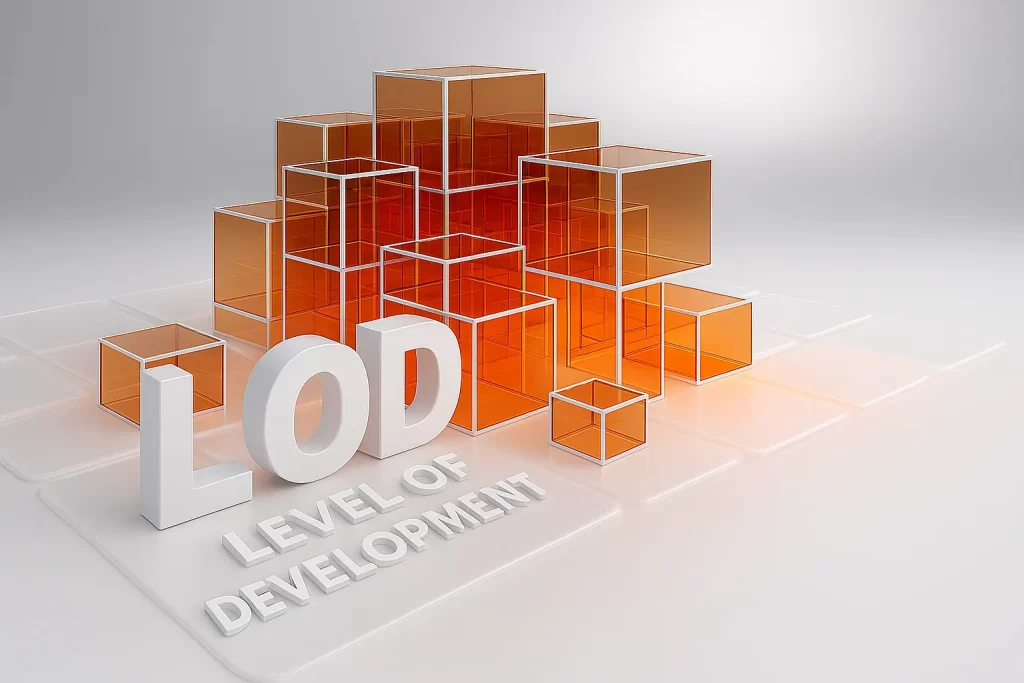
In the world of Building Information Modeling (BIM), clarity and precision are essential. That’s where Level of Development (LOD) comes in—a standardized framework that defines how much detail and reliability a BIM element should have at different stages of a project. Understanding LOD is critical for architects, engineers, contractors, and owners to ensure smooth collaboration and accurate deliverables.
What is LOD in BIM?
LOD refers to the degree of completeness and accuracy of a BIM element. It sets expectations for geometry, data, and documentation at each stage of design and construction. The American Institute of Architects (AIA) and BIMForum have standardized LOD into five main levels: LOD 100, 200, 300, 400, and 500.
LOD Levels Explained
LOD 100 – Conceptual
- Represents a symbolic model with approximate geometry.
- Used for early feasibility studies and massing.
- Example: A placeholder for a wall without thickness or material details.
LOD 200 – Approximate Geometry
- Elements have generic shapes and approximate dimensions.
- Suitable for schematic design and preliminary coordination.
- Example: A wall with estimated thickness and location but no detailed specs.
LOD 300 – Precise Geometry
- Elements are accurately sized and located.
- Used for detailed design and coordination.
- Example: A wall with exact dimensions, materials, and openings.
Explore our Architectural BIM Services and Structural BIM Services for LOD 300 deliverables.
LOD 400 – Fabrication
- Includes fabrication-level details for construction.
- Used for shop drawings and prefabrication.
- Example: A wall with reinforcement details and installation instructions.
Learn how our BIM Coordination Services support LOD 400 workflows.
LOD 500 – As-Built
- Represents the final installed condition.
- Used for facility management and lifecycle operations.
- Example: A wall with verified dimensions and maintenance data.
Discover our Scan-to-BIM Services for accurate as-built models.
Why LOD Matters
- Clear Expectations: Defines what information is available at each stage.
- Better Coordination: Reduces clashes and RFIs.
- Cost Control: Prevents over-modeling and unnecessary detailing.
- Lifecycle Value: Supports operations and maintenance post-construction.
Partner with CMLC Consulting
We deliver BIM models at every LOD stage—from conceptual design to as-built documentation. Whether you need LOD 300 for coordination or LOD 500 for facility management, we’ve got you covered.
Get a Quote today and ensure your BIM workflows meet industry standards.