In the AEC industry, coordination has always been one of the biggest challenges. Before the adoption of Building Information Modeling (BIM), project teams relied heavily on experience, assumptions, and manual reviews to catch issues. This often meant that errors were only discovered on-site, leading to costly rework, delays, and frustration.
Today, BIM has completely transformed how coordination happens across architectural, structural, and MEP disciplines. Instead of depending on guesswork, project decisions are now backed by data-driven insights, clash detection tools, and crystal-clear visualizations.
Let’s break down how BIM changed the game.
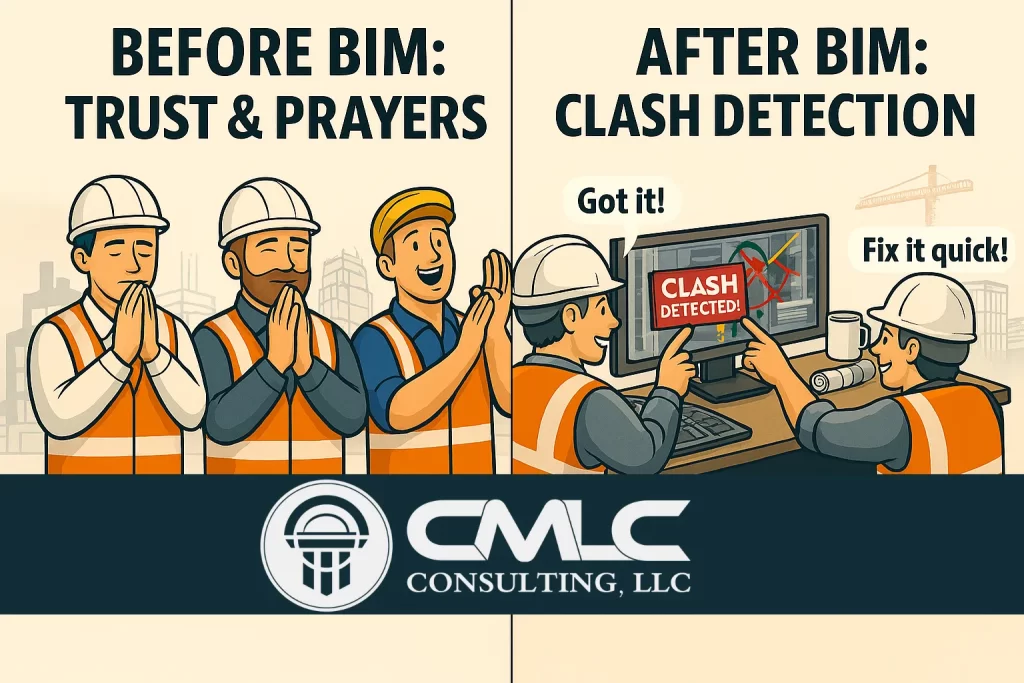
Before BIM: Trust, Assumptions & Hope
In traditional workflows, coordination relied on:
- Manual 2D drawing overlays
- Experience-based judgment
- Limited visualization
- High risk of missing clashes
- Late discovery of design conflicts
Teams often had no choice but to hope everything fits on site—a risky and expensive way to execute large projects.
After BIM: Clash Detection, Data & Confidence
BIM replaces assumptions with accuracy.
Using tools like Navisworks, Revit, and BIM 360, teams can:
- Detect clashes between MEP, structural, and architectural elements early
- Generate screenshots and reports for quick issue resolution
- Collaborate in real-time across disciplines
- Reduce RFIs and eliminate major coordination headaches
- Improve constructability before construction starts
Instead of relying on hope, BIM empowers teams with visual proof, clear documentation, and automated detection.
Why This Change Matters
The shift from traditional coordination to BIM-driven workflows results in:
1. Fewer On-Site Surprises
Clashes like duct passing through beams or pipes colliding with walls are identified during preconstruction—not during installation.
2. Better Communication
Screenshots, markups, and clash reports create a shared understanding among all stakeholders.
3. Faster Decision-Making
With clear visuals and data, teams can solve problems in minutes rather than days.
4. Higher Project ROI
Early error detection directly reduces:
- Rework
- Material wastage
- Labor cost overruns
5. Greater Confidence in the Design
Stakeholders know exactly what will be built—no ambiguity.
How Expert BIM Services Help
If your team is struggling with coordination challenges, outsourcing to a professional BIM partner can elevate your project outcomes. Expert BIM services offer:
- Clash detection & resolution
- MEP, architectural & structural modeling
- Constructability analysis
- Accurate quantity takeoffs & 3D visualization
- Scan-to-BIM for renovation and as-built modeling
Professional teams bring consistency, advanced tool expertise, and proven workflows that prevent issues before they escalate.
Final Thoughts
The evolution from “trust and luck” to “data and accuracy” is what makes BIM indispensable today. BIM doesn’t just improve workflows—it builds confidence, saves money, and ensures projects run smoothly.